
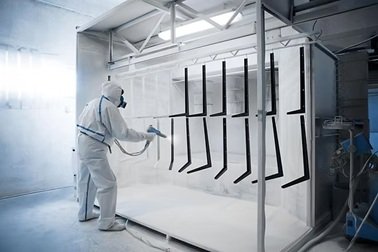
Peak-performing powder coating facilities rarely achieve efficiency by accident. Consistent throughput, reliable finish quality, controlled operating costs, and predictable production schedules are usually the result of well-designed equipment working together as a complete system. Operations that outperform competitors often share the same characteristics: streamlined workflows, dependable curing environments, effective pretreatment, and equipment designed specifically for powder coating rather than adapted from unrelated processes.
Integrated Pretreatment and Surface Preparation Systems That Reduce Rework
Successful coating operations understand that finish quality begins long before powder reaches the part. Dirt, oil, oxidation, and fabrication residue can compromise adhesion, creating defects that often require costly rework after curing.
Efficient facilities eliminate contamination early in the process. Dedicated cleaning solutions such as manual wash enclosures, multi-stage washers, steam units, spray wands, and blast rooms help create uniform surface conditions before coating begins, allowing downstream equipment to perform more consistently.
Material Handling Systems That Maintain Continuous Production Flow
Productivity suffers whenever parts sit idle between production stages. Excessive manual transport, congested staging areas, and inefficient layouts can create delays that reduce throughput even when equipment itself performs properly.
Modern finishing operations focus heavily on movement efficiency. Overhead conveyors, floor-mounted track systems, rolling carts, and automated transfer methods help maintain a steady progression from pretreatment through curing, reducing downtime while improving labor utilization throughout the facility.
Powder Application Environments Designed Specifically for Powder Performance
Spray booth design influences more than workplace cleanliness. Airflow characteristics directly affect transfer efficiency, powder consumption, operator visibility, and overall coating consistency during production.
Purpose-built equipment creates measurable advantages. Reliant powder coating systems utilize booths engineered specifically for powder applications, incorporating airflow patterns designed to improve containment, visibility, and coating uniformity while helping reduce wasted material.
Uniform Airflow Engineering That Supports Consistent Cure Profiles Every Day
Reliable finish quality depends on more than reaching a target temperature. Heat must be distributed evenly throughout the curing chamber so every surface receives the same thermal exposure during the curing cycle.
Engineered convection systems help create those conditions. Reliant powder curing ovens use dual-inlet and dual-outlet airflow designs that circulate heated air throughout the enclosure, helping minimize temperature variations that can affect coating appearance and durability.
Thermal Retention Systems That Minimize Fuel Consumption and Heat Loss
Energy efficiency remains a major factor in operating costs, especially for facilities running multiple shifts. Excessive heat loss forces burners to work harder, increasing fuel consumption while making temperature control more difficult.
Well-insulated equipment helps solve that challenge. Reliant powder coating ovens feature six-inch-thick insulated walls and roofs, along with heavily insulated door assemblies, allowing facilities to maintain curing temperatures more efficiently while reducing wasted energy.
Burner Technology That Improves Recovery Time Between Production Loads
Throughput often depends on how quickly an oven returns to operating temperature after loading and unloading cycles. Slow recovery can create bottlenecks that limit daily production capacity.
Advanced combustion systems provide an advantage in this area. Reliant industrial powder coating oven designs utilize Power Flame forced-induction burner technology engineered to deliver responsive temperature control, faster recovery times, and improved fuel efficiency throughout production.
Modular Equipment Designs That Adapt to Future Production Requirements
Manufacturing demands rarely remain static. New contracts, larger parts, and increased production volumes can quickly expose the limitations of equipment that cannot adapt to changing requirements.
Flexible infrastructure helps protect long-term investments. Reliant powder coating equipment incorporates modular construction that allows many systems to be expanded, reconfigured, or relocated without extensive modifications, helping businesses grow without replacing entire production lines.
Intelligent Controls and Data Tracking That Improve Process Consistency
Repeatable results require more than operator experience alone. Facilities that consistently produce high-quality finishes often rely on monitoring systems that help maintain stable operating conditions from one batch to the next.
Advanced control technology supports that objective. Many Reliant powder coating equipment package configurations offer PID-based controls, touchscreen HMIs, programmable logic systems, and integrated data logging capabilities that provide valuable process visibility and documentation.
Equipment Reliability Supported by Premium Components and Long-Term Serviceability
Unexpected downtime remains one of the most expensive challenges facing any finishing operation. Equipment failures can delay shipments, disrupt schedules, and increase maintenance costs when components are difficult to source or service.
Dependable operations typically invest in proven equipment foundations. Manufacturers evaluating a Reliant powder coating oven for sale often recognize the value of premium burners, heavy-duty motors, robust steel construction, accessible service points, and factory-supported engineering. Across industries ranging from fabrication and heavy equipment manufacturing to architectural finishing, Reliant Finishing Systems helps businesses build efficient powder coating operations through integrated equipment solutions designed to improve productivity, consistency, fuel efficiency, and long-term operational performance.
